
After a stop-start month of mud, setbacks, and the occasional head-scratch, the foundations for our new house build are finally in the home straight — and what a ride it’s been.
Where It All Began
When we first broke ground in February, the excitement was something else. We’d spent so long waiting for things to actually happen at the farm that we’d deliberately kept our expectations in check — telling ourselves not to get carried away until the diggers were actually on site and the trenches were being dug.
And then they were. And we got excited. Properly excited.


The Ground Had Other Ideas
As it turned out, we probably shouldn’t have.
After what had been one of the wettest starts to the year in recent memory, the soil was absolutely saturated — and it showed. The freshly dug trenches began to collapse under the weight of all that moisture, leaving us with no choice but to fill them back in and wait.
It was a proper lesson in not counting your chickens — or in our case, not counting your foundations.
While We Waited — Small Signs of Life
The wait could have felt pretty demoralising, but the team kept busy — and every now and then, something would appear on site to remind us that things were still moving, even if slowly.
Drainage equipment, piles of gravel and hard-standing delivered. Nothing dramatic, nothing Instagram-worthy — just the quiet, unglamorous work of a site being steadily prepared. Each little pile felt like a small signal that the project hadn’t gone to sleep entirely, and that was enough to keep spirits up.
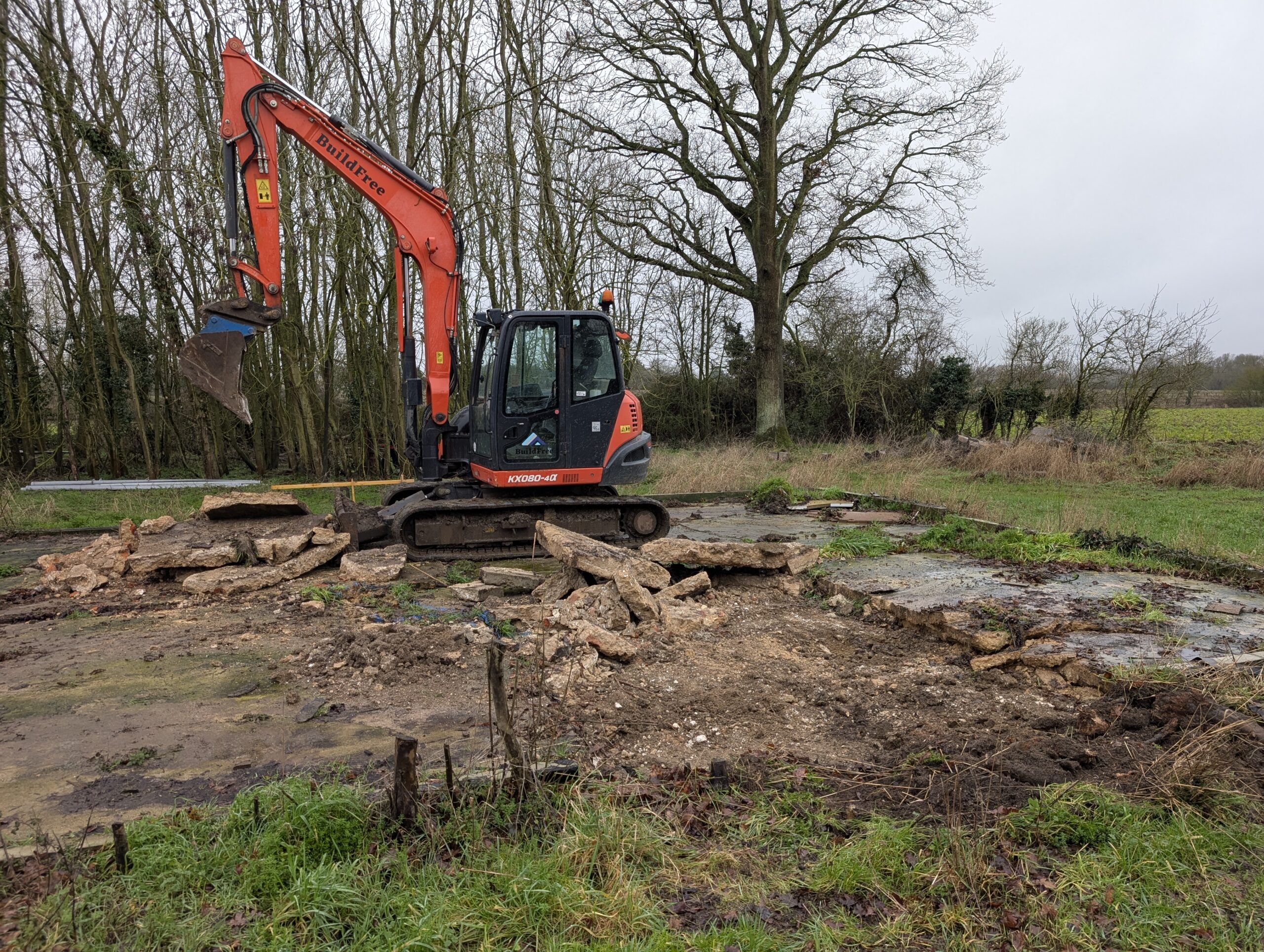
The bigger job during this period was breaking up and removing the old silo bases — the thick concrete pads that had sat in the farmyard long after the silos themselves were gone. There were three of them, and each one took a full day to remove. The concrete was substantial, and with steel rings embedded throughout, it was hard, noisy, unrelenting work. But one by one they came out, and with each one gone, the site started to look less like an old farmyard and more like somewhere a house might actually be built one day.

Back to It — And the Trenches Collapse Again
After nearly a month of waiting, the builders returned to site about a week ago. The weather had been far kinder — gentler rainfall over the preceding weeks, and then almost a full week of no rain at all. Conditions were looking promising.
The team started digging the trenches again. And they collapsed again.


This time, though, there was no question of filling them back in and waiting. Instead, the team adapted — wooden shuttering was built around the trenches to hold back the mud and contain the concrete. It was an extra layer of complexity, but it kept things moving.
A Brief Detour Through Bureaucracy
Before we could even think about building control turning up to inspect the trenches, we had a rather stressful few weeks navigating a new requirement from Colchester Council. Before building control would get involved, we needed to provide proof that services — water, power, and broadband — could be connected to the site.
Water and power we already had sorted, but broadband was a little more complicated.
Fortunately, CountyBroadband had a port just outside the farmyard, which made them the obvious choice. Less fortunately, they were rather slow getting back to us with a quote. Our builder had a contact there who was kind enough to provide an unofficial quote to help us get the application moving — but building control weren’t happy with it. Their sticking point? The quote came in at £4,000, which prompted them to ask why we hadn’t explored an OpenReach connection if CountyBroadband wasn’t straightforward.
Come the Friday before we were due to start on the foundations, we still didn’t have confirmation that building control were happy to proceed. It was, to put it mildly, a tense few days.
And then the official quote from CountyBroadband came through. For £0. Free. Nothing. Not a penny.
Even better, they’ve agreed to send the ducting to the farm now, so it can be laid at the same time as the ducting for power and water — even though we won’t actually get the internet connection until the house is ready to move into, which is still the best part of a year away. A small but very welcome win.
The Big Pour
By the end of the Monday, the trenches were mostly dug, and some shuttering was in place. Tuesday was earmarked for the pour — and it was quite a day. The entire team were on site first thing, scrambling to get the shuttering fully in place before building control arrived — it had all the energy of that inevitable last-hour rush on Changing Rooms or Extreme Makeover: Home Edition, everyone flat out, clock ticking.
Building control arrived on site before midday for their inspection. There was one moment of anticipation when they queried the depth of the trenches nearest the trees — regulations required 1.9 metres at that point. As it turned out, the team had already anticipated this, and the trenches were exactly that. Inspection passed, pour approved, and right on schedule, around midday, the first of the cement trucks rolled in.
Ten of them in total, on rotation, throughout the day.


What followed was a long, gruelling day of pouring concrete whilst simultaneously battling the collapsing trench walls — a constant push and pull of progress against the mud. The team didn’t stop. They kept going as the light faded, working on into the evening under darkness, until the last of the concrete was poured at around 11pm.
Ten large cement trucks. A race against the mud. A team that didn’t down tools until the job was done. It’s the kind of day that makes you very glad you hired the right people.
Keeping the Budget in Check
One silver lining throughout all of this? So far, we’ve managed to stay within budget. When foundations throw up complications, costs can run away with themselves sharpish — so keeping a close eye on the pennies while navigating the delays is something we’re quietly rather pleased about.
What’s Still To Do
The hardest part of the groundworks is now firmly behind us — but there’s still a week or so of work to get through before everything is fully complete.
The installation of the treatment tank still needs to be completed, and the team will then be turning their attention to the soakaways, the associated soil and drain pipes, and the inspection chambers. On top of that, the middle section still needs to be dug out and the slab poured.
In the last day or two, the site has also seen a steady procession of tractor-trailers carting away the excess clay that was excavated during the dig — around 200 tonnes of the stuff. Watching that much material leave the site is oddly satisfying — a very visible reminder of just how much work has gone into the ground.


We’re nearly there. The finish line is in sight, and for the first time in a while, we’re allowing ourselves to feel just a little bit excited about it.


Leave a Reply